
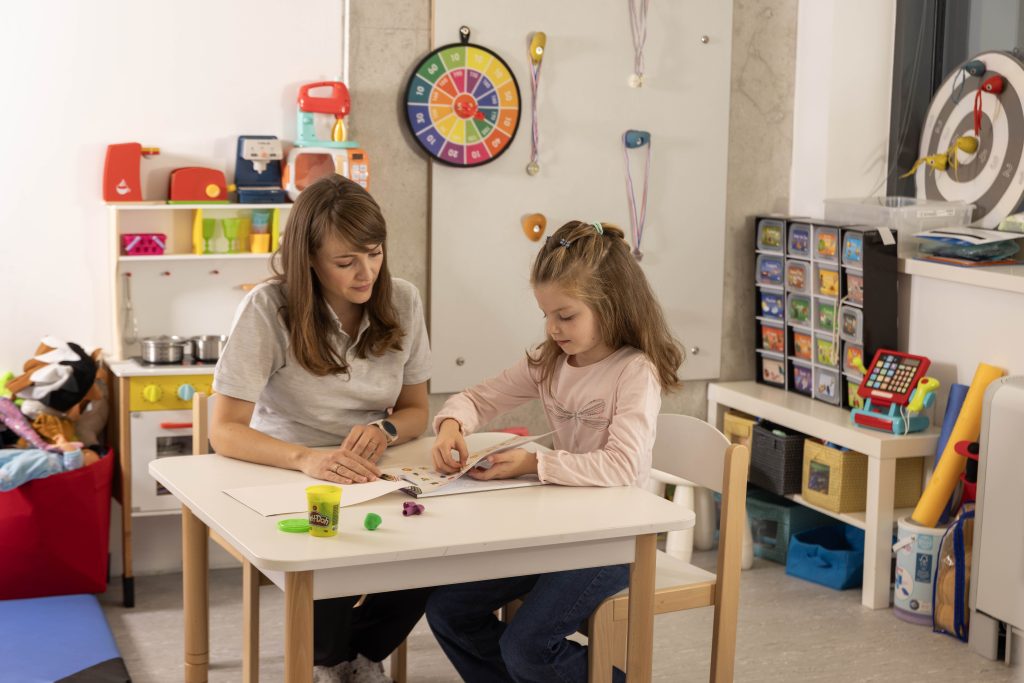
Starting school is one of the most significant milestones in a child’s life, as well as for their parents. It is a time when children are expected to adapt to a new environment, new rules, a structured daily routine, and increased social demands.
Although school readiness is often associated only with knowing letters and numbers, it is actually a much broader concept. A child needs to be prepared emotionally, physically, socially, and independently in order to feel confident and successful in the school environment.
In this process, occupational therapy can play an important role by helping children develop the skills they need for everyday functioning at school.
What Does School Readiness Actually Mean?
- the ability to manage basic self-care tasks
- emotional stability and the ability to cope with frustration
- well-developed motor skills needed for writing and play
- the ability to communicate and participate in a group setting
- attention skills and the ability to follow instructions
How Does Occupational Therapy Help Prepare Children for School?
Occupational therapists work with children through play and everyday activities to help them develop the skills needed for school.
The focus is not only on academic knowledge but also on building the foundational skills that support learning.
Development of Fine Motor and Pre-Writing Skills
One of the most important requirements at school is the ability to use the hands for precise tasks. Writing, drawing, using scissors, and opening school supplies all require good control of the hand and finger muscles.
Children who experience difficulties with fine motor skills often tire quickly when writing or avoid tasks that require precision.
Through play-based activities, occupational therapy helps children develop hand strength and control, for example through modeling clay, bead threading, drawing, and coloring. Although these may appear to be simple activities, they actually build the foundation for school-related skills such as writing.
Gross Motor Skills, Balance, and Posture
Before a child can sit still and write, they need to have a stable body. Core strength, balance, and coordination allow children to sit upright, move safely, and participate in playground activities.
When a child experiences difficulties in this area, they may tire quickly, slump in their chair, or have difficulty transitioning between activities.
Through activities such as climbing, jumping, carrying, and pushing objects, children develop the muscles and skills they need to maintain stability in the classroom.
Sensory Processing and Self-Regulation
The school environment can be highly demanding on a child’s senses due to noise, bright lights, large groups of people, and constant transitions between activities. Some children process these sensory inputs more easily, while for others they can be overwhelming.
Occupational therapy helps children better understand their own sensory needs and learn strategies to calm or activate themselves when necessary. This may include short sensory breaks, activities involving deep pressure or movement, and environmental adaptations.
The goal is to help the child become “organized in their body” — calm enough to focus, yet alert enough to actively participate in learning.
Self-Regulation and Emotional Skills
Starting school brings a range of new emotions, including excitement, fear, uncertainty, and frustration. Children who are still learning to regulate their emotions may find these situations particularly challenging.
Occupational therapy helps children recognize their emotions and learn effective ways to manage them. This may include simple self-calming strategies, role-playing activities, and learning social skills such as taking turns or asking for help.
When children know how to calm themselves and manage their emotions, they can adapt more easily to the school day and develop greater self-confidence.
Independence in Daily Activities
At school, children are expected to demonstrate a certain level of independence — from dressing and eating to taking care of their personal belongings.
Occupational therapy helps children develop these skills step by step, enabling them to feel confident without constant assistance from adults.
When a child can independently open their lunchbox or put on their jacket, they feel more capable and better prepared for school.
Attention and Following Instructions
In the school environment, children are expected to listen to instructions, maintain attention, and complete tasks. For some children, this can be challenging, especially if they experience difficulties with self-regulation or sensory processing.
Occupational therapy helps through play-based activities that develop focus, structure, and the ability to follow multiple-step instructions.
In this way, children gradually build their “learning endurance.”
Play and Social Skills
A large part of the school day involves interacting with others. Children need to know how to join in play, share, take turns, and resolve minor conflicts.
Through guided play and group activities, occupational therapy helps children develop these social skills and a sense of belonging within a group.
Conclusion
School readiness is not a single skill but rather a combination of different developmental areas that together enable a child to make a successful transition into school.
Occupational therapy helps build these foundations through play, movement, and everyday activities, allowing children to start school feeling prepared, confident, and secure.
The goal is not to create a perfect child, but a child who feels ready to learn, explore, and participate in their school experience. If you would like to learn more about how occupational therapy can support your child, visit our occupational therapy page.
Want to Know if Your Child Is Ready for School?
Our occupational therapists can assess your child’s skills and create an individualized school readiness plan tailored to their needs.
Schedule a consultation and take the first step toward a confident and successful start to school.
