
What Is Proprioception and Why Is It Important?
Proprioception is the sense that allows a child to know where their body is in space and how it is moving without needing to look, and it plays a crucial role in movement control, balance, coordination, and attention.
Proprioception is the sense that enables us to know where our body is in space and how it is moving without having to look at it. It is often referred to as the “sixth sense” because it operates automatically, continuously sending information to the brain about body position, movement, and muscle force.
This sense is made possible by receptors located in the muscles, joints, and skin, which help the brain understand how the body is moving and how much force is required to perform specific actions.
Proprioception forms the foundation for movement control, balance and stability, coordination, the development of motor skills, as well as self-regulation and attention.
Where Do We Use Proprioception in Everyday Activities?
Proprioception is involved in almost everything we do, even when we are not consciously aware of it. We use it when we walk without looking at our feet, pick up an object without looking at our hands, write and regulate the pressure applied to a pencil, climb stairs, ride a bicycle or run, maintain balance, or carry objects of different weights.
Without proprioception, everyday activities would be much more difficult and less safe to perform, as we would need to constantly rely on visual feedback to control every movement.
What Causes Difficulties with Proprioception?
Difficulties arise when the brain does not receive or process information from the body correctly. This may be associated with neurodevelopmental conditions such as ADHD or autism spectrum disorder (ASD), as well as sensory processing difficulties, developmental motor challenges, or reduced sensory integration.
When the proprioceptive system is not functioning optimally, a child may experience difficulties with judging force, body position, and movement coordination.
How Can You Recognize Proprioceptive Difficulties in Children?
A child with proprioceptive difficulties may appear clumsy and frequently bump into objects, have difficulty judging the amount of force needed when grasping objects, demonstrate poor handwriting, and struggle with fine motor tasks.
They may often seek intense sensory input through activities such as jumping, pushing, and climbing, have poor posture, and fatigue easily. Difficulties with attention, self-regulation, and energy control may also be present.
Some children constantly seek movement to help “organize” their bodies, while others avoid certain activities because they feel insecure or unsteady. Proprioception affects not only movement but also behavior, concentration, and emotional regulation.
How Can Proprioception Be Encouraged in Children?
“Heavy Work” Activities
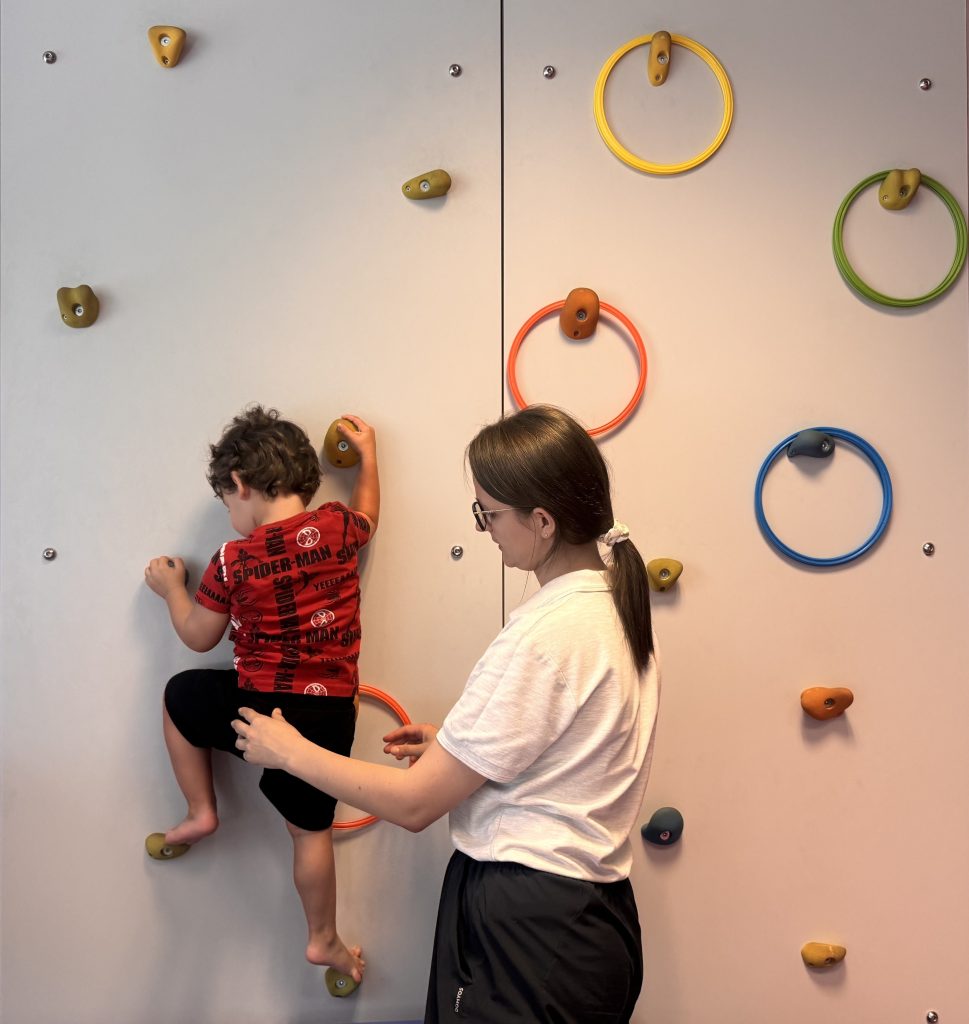
Jumping and Climbing
Activities such as jumping on a trampoline, jumping exercises, and climbing help develop coordination, strength, and body control.
Deep Pressure and Regulation
When Should Proprioceptive Activities Be Used?
Conclusion
Concerned About Your Child’s Development?
If you notice difficulties with your child’s movement, attention, or self-regulation, a professional assessment can help identify the underlying causes and determine the most appropriate approach to support their development.
Contact us to schedule an assessment appointment.